

/fdata%2F3402445%2Favatar-blog-1127529851-tmpphpOIoeuT.jpg)
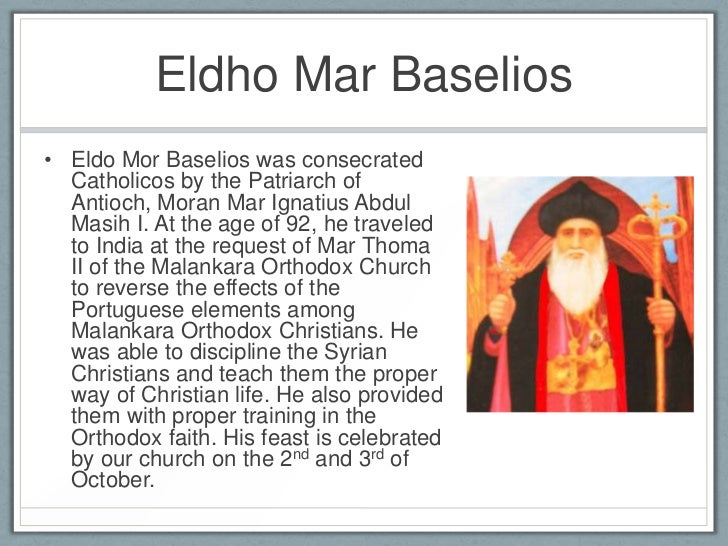
Saint Baselios Yeldho (Kothamangalam Bava)
/http%3A%2F%2Fmosc.in%2Fwp-content%2Fuploads%2F2015%2F05%2Fbasil.jpg)
/http%3A%2F%2Fstpaulbrisbane.org%2Fkandila.gif)
Saint Baselios Yeldo était le Maphrian de l'Est de l'Église Syriaque Orthodoxe de 1678 jusqu'à sa démission en 1684.
Il est vénéré comme saint dans l'Eglise Syrienne Orthodoxe de Malankara (Eglise Orthodoxe des Indes, notre Eglise-mère, et l'Église Syriaque-Orthodoxe.
Sa Fête est fixée au 2 Octobre.
Le 2 novembre 1947, Baselios Yeldo a été proclamé Saint par Sa Sainteté Baselios Geevarghese II , Catholicos de l'Est et Métropolite du Malankare et, plus tard, le 20 octobre 1987, par Sa Sainteté Ignatius Zakka I Iwas, Patriarche de l'Eglise Syriaque Orthodoxe d'Antioche et de Tout l'Orient.]
Yeldo est né en 1593 dans le village de Bakhdida, près de la ville de Mossoul, et, tout jeune, devint moine au monastère de Saint-Behnam.
Il fut consacré Maphrian de l'Est en 1678 par Sa Sainteté Ignace Abded Mshiho I, Patriarche Syriaque d'Antioche et de Tout l'Orient.
En 1683, Sa Sainteté Ignace Abded Mshiho I, Patriarche Syriaque-Orthodoxe d'Antioche, reçut une lettre et, plus tard, une délégation de Mar Thoma II, archevêque de Malankara, demandant aux autorités de l'Eglise d'Antioche d'aider l'Eglise Orthodoxe des Indes de contrer les tentatives portugaises d'anéantir la Tradition Syriaque au Malankare.
/http%3A%2F%2Fcatholicatenews.in%2F~mosc%2Fwp-content%2Fuploads%2F2015%2F03%2FyELDO-MAR-BASELIOS-BAVA.jpg)
L'année suivante, le Patriarche organisa une réunion d'ecclésiastiques au monastère de Saint Ananias pour discuter de la situation et de l'état de l'Église du Malankare et décider qui devrait être envoyé.
Yeldo se porta volontaire pour se rendre au Kerala (Malankare) et, dès lors, démissionna de sa charge de Maphrian.
Le patriarche et les évêques exprimèrent des inquiétudes quant à la santé et à l'âge du saint, mais, finalement, le Patriarche accorda à Yeldo l'autorisation d'entreprendre le voyage et d'assumer cette exaltante mission de secourir l'Eglise des Indes.
Dès lors, le saint retourna au monastère de Saint-Matthieu pour y préparer son voyage en Inde.
Les moines Joea et Matthieu, des monastères respectifs de Saint-Matthieu et de Saint-Behnam , l'évêque Ivanios Hidyat Allah ainsi que le frère d'Yeldo: Jamma, le rejoignirent par le chemin du sud à Basra.
Le groupe voyaga par voie maritime de Basra à Thalassery, via Surat, pour arriver en 1685. Mais en raison des menaces occasionnées par les Portugais et les pirates, Yeldo et ses compagnons décidèrent de poursuivre leur voyage vers Kothamangalam par voie terrestre et sous un déguisement civil.
Il advint que, lors du voyage, le groupe rencontra un tigre que Yeldo éloigna par un simple signe de Croix dans sa direction. Le fauve prit la fuite.
Plus tard, arrivant au village de Pallivas, éclairé par la grâce, il eut la connaissance d'une forte inondation affligerait le village dans la nuit. Il conseilla aux villageois d'aller dormir dans les collines. Ceux qui suivirent le saint et ses compagnons survécurent alors que, malheureusement, les animaux et les villageois qui étaient restés en bas furent noyés.
Ivanios et Yeldo continuèrent leur route jusqu'à Kozhippilli, près de Kothamangalam, où Ivanios accepta de se cacher dans un arbre jusqu'à ce que Yeldo y fût entré car il était considéré comme dangereux de voyager ensemble.
C'est plus tard, qu'il atteignit la rivière Periyar et, rencontrant là un homme qui gardait là son bétail, lui demanda de le conduire vers l'église locale de Saint Thomas. L'homme se déroba, lui déclarant qu'il ne pouvait pas le faire en raison de son bétail qu'il devait garder en sécurité. Dès lors, Yeldo dessina de son bâton de marche dans la poussière du sol, un cercle dans lequel le bétail put se réfugier. Le bétail ne pas quittait pas le cercle. Voyant cela, l'homme confia au saint les difficultés que rencontrait sa sœur qui était en plein "travail d'enfantement". Yeldo demanda de l'eau. L'homme grimpa dans un cocotier rapporta deux noix de coco. Yeldo bénit l'une des noix de coco et dit à l'homme de porter l'eau cette eau de coco bénite à sa sœur.
L'homme revint un peu plus tard avec l'heureuse nouvelle que sa sœur avait donné naissance à un garçon.
Puisque pendant tout ce temps le bétail était tranquillement resté dans le cercle, l'homme a accepta de conduire Yeldo jusqu'à l'église locale.
Une fois Yeldo ayant été accueilli, les membres de la communauté de l'Eglise Saint Thomas se dirigèrent vers Kozhippilli munis du mouchoir de Yeldo pour y récupérer Ivanios.
Celui-ci, craignant que ces gens n'aient assassiné le saint, refusa de descendre de son arbre. Il fallut que le diacre local qui parlait Syriaque montra à l'évêque le mouchoir pour que celui-ci fut convaincu de les suivre jusqu'à Kothamangalam.
À Kothmangalam, lors de la Fête de la Sainte Croix, Yeldo consacra Ivanios Hidyat Allah comme archevêque pour aider réorganiser la hiérarchie cléricale et combattre ainsi les menées des portugais contre l'Église de Malankare.
En raison de son grand âge et des fatigues du voyage, trois jours plus tard le saint tomba malade et mourut le 29 septembre 1685. Un énorme bloc de granit grossier qui était en l'église Saint-Thomas s'alluma au moment de sa mort.
/http%3A%2F%2Fwww.syriacchristianity.info%2Fbio%2FKoth_Kabar.jpg)
Saint Baselius Yeldo was the eastern Maphrian of the Orthodox Syriac Church from 1678 until his resignation in 1684.

He is venerated as a saint in the Orthodox Syrian Orthodox Church of Malankara (Orthodox Church of India, our mother-church, and the Syriac-Orthodox Church.
His Feast is fixed on October 2nd.
On 2 November 1947 Baselios Yeldo was proclaimed Saint by His Holiness Baselios Geevarghese II, Catholicos of the East and Metropolitan of Malankare, and later on 20 October 1987 by His Holiness Ignatius Zakka I Iwas, Patriarch of the Church Syriac Orthodox of Antioch and All the Orient.]
Yeldo was born in 1593 in the village of Bakhdida, near the city of Mosul, and at a young age became a monk at the monastery of St. Behnam.
It was consecrated Eastern Maphrian in 1678 by His Holiness Ignatius Abded Mshiho I, Syriac Patriarch of Antioch and All the East.
In 1683, His Holiness Ignatius Abded Mshiho I, the Syriac-Orthodox Patriarch of Antioch, received a letter and later a delegation from Mar Thoma II, Archbishop of Malankara, asking the authorities of the Church of Antioch to help the Orthodox Church of India to counter the Portuguese attempts to annihilate the Syriac Tradition at Malankare.
The following year the Patriarch organized a meeting of ecclesiastics at the monastery of Saint Ananias to discuss the situation and state of the Malankare Church and decide who should be sent.
Yeldo volunteered to go to Kerala (Malankare), and from that time resigned from his office in Maphrian.
The Patriarch and the bishops expressed concern about the health and age of the saint, but in the end the Patriarch granted Yeldo permission to undertake the journey and to assume this exalting mission to help the Church of India.
From then on, the saint returned to the monastery of St. Matthew to prepare his journey to India.
The monks Joea and Matthieu, the respective monasteries of Saint Matthew and Saint Behnam, Bishop Ivanios Hidyat Allah and Yeldo's brother Jamma, joined him on the southern route to Basra.
The group traveled by sea from Basra to Thalassery, via Surat, to arrive in 1685. But due to the threats caused by the Portuguese and the pirates, Yeldo and his companions decided to continue their journey to Kothamangalam by land and disguise civil.
It happened that during the trip, the group met a tiger that Yeldo moved away by a simple sign of the Cross in his direction. The wild beast fled.
Later, arriving at the village of Pallivas, enlightened by grace, he had the knowledge of a strong flood afflicting the village at night. He advised the villagers to go to sleep in the hills. Those who followed the saint and his companions survived while, unfortunately, the animals and villagers who had remained below were drowned.
Ivanios and Yeldo continued on their way to Kozhippilli, near Kothamangalam, where Ivanios agreed to hide in a tree until Yeldo entered it because it was considered dangerous to travel together.
It was later that he reached the Periyar River and, meeting a man who kept his cattle there, asked him to take him to the local church of St. Thomas. The man slipped away, declaring that he could not do it because of his cattle, which he had to keep safe. From then on, Yeldo drew a circle from his walking stick in the dust of the ground, in which the cattle were able to take refuge. The cattle did not leave the circle. Seeing this, the man confided to the saint the difficulties encountered by his sister who was in the midst of "child labor." Yeldo asked for water. The man climbed into a coconut tree and brought back two coconuts. Yeldo blesses one of the coconuts and tells the man to bring the holy coconut water to his sister.
The man returned a little later with the happy news that his sister had given birth to a boy.
Since all this time the cattle had quietly stayed in the circle, the man agreed to drive Yeldo to the local church.
Once Yeldo had been welcomed, members of the community of St. Thomas Church went to Kozhippilli with Yeldo's handkerchief to get Ivanios back.
The latter, fearing that these people had murdered the saint, refused to descend from his tree. It was necessary that the local deacon who spoke Syriac showed the bishop the handkerchief so that the latter was convinced to follow them as far as Kothamangalam.
In Kothmangalam, during the Feast of the Holy Cross, Yeldo consecrated Ivanios Hidyat Allah as Archbishop to help reorganize the clerical hierarchy and thus fight against the conduct of the Portuguese against the Church of Malankare.
Due to his great age and the fatigues of the journey, three days later the saint fell ill and died on September 29, 1685. An enormous block of coarse granite which was in the Church of St. Thomas was lit at the time of his death .

(Tomb of Baselios Yeldo at the Church of Saint Thomas, Kothamangalam )
São Baselius Yeldo era o maphrian oriental da Igreja siríaca ortodoxa de 1678 até sua renúncia em 1684.
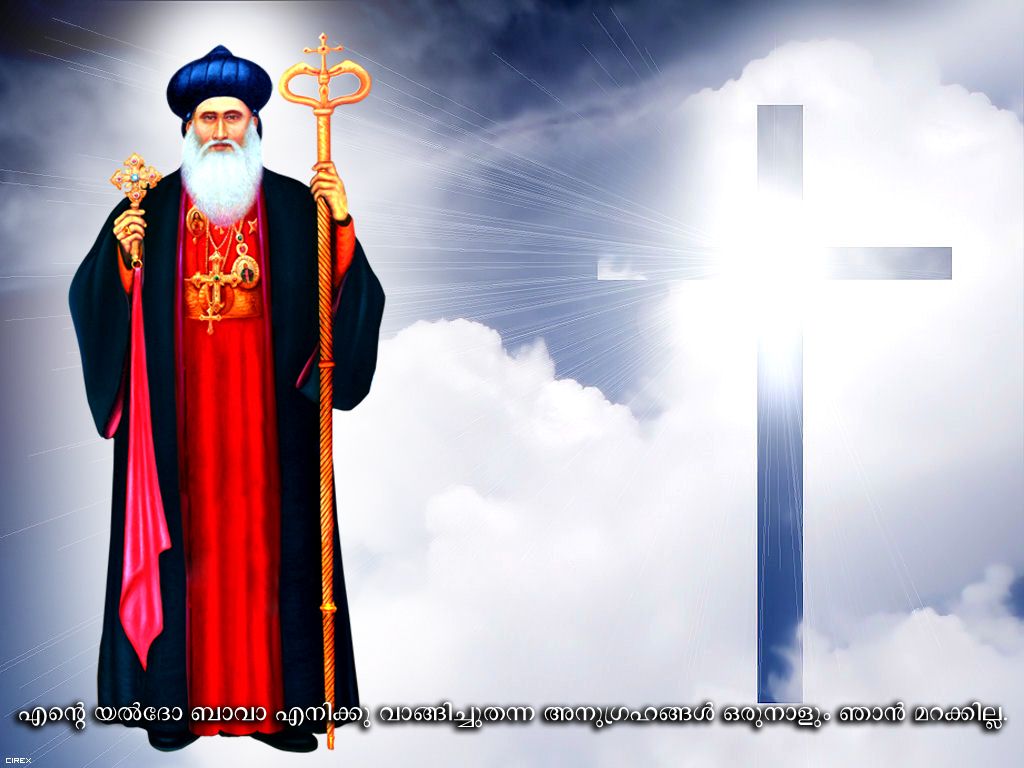
Ele é venerado como um santo na Igreja Ortodoxa Ortodoxa Ortodoxa de Malankara (Igreja Ortodoxa da Índia, nossa igreja-mãe e Igreja Syriac-Ortodoxa.
Sua festa é fixada no dia 2 de outubro.
Em 2 de novembro de 1947, Baselios Yeldo foi proclamado Santo por Sua Santidade Baselios Geevarghese II, Catholicos do Oriente e Metropolitano de Malankare, e mais tarde em 20 de outubro de 1987 por Sua Santidade Ignatius Zakka I Iwas, Patriarca da Igreja Syriac Ortodoxo de Antioquia e de todo o Oriente.]
Yeldo nasceu em 1593 na aldeia de Bakhdida, perto da cidade de Mosul, e em uma idade jovem tornou-se um monge no mosteiro de São Behnam.
Foi consagrado Maphrian oriental em 1678 por Sua Santidade Inácio Abded Mshiho I, Patriarca siríaco de Antioquia e Todo o Oriente.
Em 1683, Sua Santidade Inácio Abded Mshiho I, o Patriarca Sirrio-Ortodoxo de Antioquia, recebeu uma carta e depois uma delegação de Mar Thoma II, Arcebispo de Malankara, pedindo às autoridades da Igreja de Antioquia que ajudem a Igreja Ortodoxa da Índia para combater as tentativas portuguesas de aniquilar a tradição siríaca em Malankare.
No ano seguinte, o Patriarca organizou uma reunião de eclesiásticos no mosteiro de São Ananias para discutir a situação e o estado da Igreja de Malankare e decidir quem deveria ser enviado.
Yeldo se ofereceu para ir a Kerala (Malankare), e desde então renunciou a seu escritório em Maphrian.
O Patriarca e os bispos expressaram preocupação com a saúde e a idade do santo, mas, no final, o Patriarca concedeu a Yeldo permissão para empreender a jornada e assumir esta missão exaltante para ajudar a Igreja de Índia.
A partir de então, o santo voltou ao mosteiro de São Mateus para preparar sua jornada para a Índia.
Os monges Joea e Matthieu, os respectivos mosteiros de São Mateus e São Behnam, o bispo Ivanios Hidyat Allah e o irmão de Yeldo, Jamma, se juntaram a ele na rota do sul de Basra.
O grupo viajou pelo mar de Basra para Thalassery, via Surat, para chegar em 1685. Mas devido às ameaças causadas pelos portugueses e pelos piratas, Yeldo e seus companheiros decidiram continuar sua jornada para Kothamangalam por terra e disfarçar civil.
Aconteceu que durante a viagem, o grupo encontrou um tigre que Yeldo se afastou por um simples sinal da Cruz em sua direção. A fera selvagem fugiu.
Mais tarde, chegando à aldeia de Pallivas, iluminada pela graça, teve o conhecimento de uma forte inundação que aflige a aldeia à noite. Ele aconselhou os aldeões a dormir nas colinas. Aqueles que seguiram o santo e seus companheiros sobreviveram enquanto, infelizmente, os animais e aldeões que haviam permanecido abaixo eram afogados.
Ivanios e Yeldo continuaram a caminho de Kozhippilli, perto de Kothamangalam, onde Ivanios concordou em se esconder em uma árvore até Yeldo entrar, porque era considerado perigoso viajar juntos.
Mais tarde, ele chegou ao rio Periyar e, encontrando um homem que manteve seu gado lá, pediu-lhe para levá-lo para a igreja local de Santo Tomás. O homem escorregou, declarando que não podia fazê-lo por causa de seu gado, que ele tinha que manter a salvo. A partir de então, Yeldo tirou um círculo da sua bengala no pó do chão, no qual o gado conseguiu refugiar-se. O gado não deixou o círculo. Ao ver isso, o homem confiou ao santo as dificuldades encontradas por sua irmã que estava no meio do "trabalho infantil". Yeldo pediu água. O homem subiu em um coqueiro e trouxe de volta dois cocos. Yeldo abençoa um dos cocos e diz ao homem que traga a água de coco sagrada para sua irmã.
O homem voltou um pouco mais tarde com a feliz notícia de que sua irmã tinha dado à luz um menino.
Como todo esse tempo o gado ficou silenciosamente no círculo, o homem concordou em dirigir Yeldo para a igreja local.
Uma vez que Yeldo foi bem-vindo, membros da comunidade da Igreja de São Tomás foram para Kozhippilli com o lenço de Yeldo para recuperar Ivanios.
O último, temendo que essas pessoas tivessem assassinado o santo, se recusasse a descer da sua árvore. Era necessário que o diácono local que falasse Syriac mostrou ao bispo o lenço para que este fosse convencido de segui-los até Kothamangalam.
Em Kothmangalam, durante a Festa da Santa Cruz, Yeldo consagrou Ivanios Hidyat Allah como arcebispo para ajudar a reorganizar a hierarquia clerical e assim lutar contra a conduta dos portugueses contra a Igreja de Malankare.
Devido à sua grande idade e às fatigas da jornada, três dias depois, o santo ficou doente e morreu em 29 de setembro de 1685. Um enorme bloco de granito grosso que estava na Igreja de Santo Tomás foi aceso no momento de sua morte .
/http%3A%2F%2Fpampakudavaliyapally.com%2Fdata_folder%2FCKE_UPLOADS%2F1419074319_kothamangalam.jpg)


/image%2F1498980%2F20260221%2Fob_0991ea_guerison-d-un-lepreux.jpg)
/image%2F1498980%2F20180221%2Fob_f3b37c_151210-icone-1.jpg)
/image%2F1498980%2F20180106%2Fob_959557_26166596-2000281610221488-330526446776.jpg)
/image%2F1498980%2F20241203%2Fob_bf41d0_417148169-10231157651227530-6485753101.jpg)
