Fondateur du Mont Saint-Michel.
En effet, une nuit, il reçut trois fois, au cours de son sommeil, l'ordre de l'Archange Saint Michel de faire ériger sur le Mont Tombe une église en son honneur.
Vu l'état de cette pointe rocheuse, à peine rattachée au continent, couverte de broussailles et de ronces et seulement habitée, outre les bêtes sauvages, par quelques ermites, il jugea cela impossible et pensa d'abord à un tour du malin.
Ce n'est que la troisième fois qu'il obéit après que l'archange, afin de mettre fin à ces hésitations, appuya fortement le doigt sur son front et y laissa une empreinte.
Aubert se réveilla avec un creux sur le front et comprit la véracité de l'ordre du saint.
Ce crâne, aussi appelé « chef de saint Aubert » est conservé aujourd'hui dans le trésor de la basilique Saint-Gervais-et-Saint-Protais d'Avranches et porte les traces d'un tel stigmate.

Des événements providentiels le guidèrent dans sa tâche : un rond de rosée, un matin de septembre, lui indiqua la forme de l'oratoire, un taureau attaché en montra l'emplacement.
Une source fut trouvée, un puits creusé.
Il fallut encore arracher une pierre cultuelle païenne.
Aubert envoya des moines chercher au sanctuaire du Mont Gargano en Italie, dédié à saint Michel, des reliques du lieu.
Puis, le 16 octobre 709, l'évêque fit la dédicace de l'église et y installa un chapitre de douze chanoines.
Le Mont Saint-Michel était né.
SAINT FINNIAN of Clonard,

/http%3A%2F%2Fstpaulbrisbane.org%2Fkandila.gif)
" Tutor of the Saints of Ireland," lived in the sixth century. He was a native of Leinster ; his birthplace is generally supposed to have been near the present town of New Ross. Saint Finnian was of the race of Ir, and belonged to the Clan na Rudhraidhe. His name appears to be a diminutive of Finn, "white." He was a contemporary of Finnian of Moville, whose name comes next in the list of saints of the second class.
Saint Abban baptized Finnian, and at an early age he was placed under the care of Bishop Fortchern of Trim. With him he remained thirty years. At the end of that period Finnian proceeded to Britain, and settled at Kilmuine or Menevia, where he placed himself under David, Gildas, and Cadoc. David was grandson of an Irish prince, Bracan. He taught St. Aidan of Ferns, was first Bishop of Menevia, and died A.D. 589. Gildas was the author of De Excidio Britannia, according to the Annals of Ulster. He died A.D 570. Cadoc is represented as cousin to St. David, and was a pupil of St. Thaddeus, an Irishman. Saint Finnian is said to have founded three churches in Britain, but they have not been identified. While a monk at the monastery of St. David, Finnian on one occasion was asked to supply the place of oeconomus, or house steward, in the absence of the monk who generally filled that office. Finnian replied that he would be unable to do so, as he was unprovided with the necessary requirements for carrying wood and provisions. His superior having insisted on his undertaking the task, Finnian obeyed, and we read in his life that an angel came to his assistance. What before had seemed an impossibility he was able to accomplish by the aid of this heavenly messenger.
How long Finnian remained at St. David's monastery is uncertain. Lanigan thinks he returned to Ireland about A.D. 520. Before leaving Britain Finnian determined to undertake a journey to Rome, but an angel warned him not to do so, but to return to his own country " Redite ad vestras plebes, Deus enim acceptat intentionem Vestram." Finnian was accompanied to Ireland by several friends, among whom special mention is made of Biteus and Genoc. On his passage to Ireland, says Dr. Lanigan, he stopped a while with his friend Caimin, and landed at the port Kille-Caireni, in Wexford.
Finnian sent messengers to Muiredeach, sovereign of Ky-Kinsellagh, asking permission to enter his territory. The king generously acceded to his request, and came himself to see Finnian, in whose presence Muiredeach prostrated himself on the ground, and promised the saint a site for a monastery. Saint Finnian erected an establishment at Achadh Abhla ; i.e., “Field of the Apple-Tree," which now bears the name Aghowle, or Aghold, in the barony of Shillelagh, County Wicklow. It was anciently called Crosalech. Here St. Finnian resided for sixteen years. At Mughna, County Carlow, he erected another monastery, and is said to have lectured there for seven years on the Sacred Scriptures. It is probably while there that he preached on one occasion in presence of St. Brigid.
We now approach the most important event in St. Finnian's life in his settlement at Clonard, County Meath, which during his lifetime became the most celebrated sanctuary in Ireland for piety and learning. Cluain-Eraird i. e., Erard's Lawn or Meadow is the derivation given by O'Donovan. Erard was a man's name, very common in Ireland, signifying lofty or noble. Again, we find it related in the saint's life that an angel appeared to him directing him as to where he should take up his abode. Saint Finnian entered Clonard repeating the psalm " Haec requies mea in Saeculum Saeculi hic habitabo quoniam elegi eam."
The date of the saint's arrival at Clonard is said to be about A.D. 530. It is a matter of doubt whether St. Finnian was a bishop. The Four Masters simply term him abbot. Such is the title accorded to him in the Martyrology of Donegal and other Irish calendars. Dr. Lanigan seems to think that St. Finnian was only abbot. It is, doubtless, a fact that Clonard was an episcopal see, but it is quite possible that it did not become so till after Finnian's time. His successor at Clonard, St. Seanach, is called bishop by the Four Masters. The school of Clonard in a short time became famous in Ireland. Those great men who were afterward called the Twelve Apostles of Ireland came to seek instruction from Finnian viz., Columba, the two Brendans, Ciaran of Saigher, his namesake of Clonmacnoise, Columb of Tir-da-ghlas, Mobhi Claraineach, Molaish, Canice, and Ruadhan of Lothra. Three thousand scholars are said to have been educated at Clonard during the saint's lifetime, and the holy founder was justly termed "Magister Sanctorum Hiberniae sui temporis." In the Life of St. Ciaran of Clonmacnoise we read : " In schola sapientissimi magistri Finniani plures Sancti Hibernise erant ;" and in that of St. Columb of Tir-da-ghlas : "Audiens famam S. Finniani Episcopi de Cluain-Eraird, ut Sacram Scripturam addisceret accessit ;" and, lastly, we find it said of St. Ruadhan :"Legens diversas Scripturas et multum proficiens in eis." Colgan enumerates thirty two saints who received instruction from St. Finnian, and bears testimony of the fame of Clonard, where students assembled from various parts of Europe.
Saint Finnian did not permit his multifarious labours in behalf of learning to interfere with his duties towards the needy and afflicted. We read in his life that he was a father to all who sought help from him: " Flebat cum flentibus." "Infirmabatur enim cum infirmis." On a certain occasion a bard named German presented St. Finnian with a beautiful poem, in which many of his virtues were extolled; the bard demanded from the saint not gold or silver, or any worldly substance, but only fertility of produce in his lands. Finnian answered him, and said : "Sing over water the hymn which thou hast composed, and sprinkle the land with that water." The bard did as he was directed, and his land produced abundant fruit.
In the historical tale "The Expedition of the Sons of Carra," published by O' Curry in his MS. Materials of Ancient Irish History, we have a description of St. Finnian's interviews with the three brothers, who had plundered the churches of Connaught. O 'Curry observes that while these tales often contain matter without resemblance to facts, we are not to reject them wholly on that account, but rather make allowance for poetic embellishment, at the same time having good ground for believing that a foundation of truth exists. The story is as follows : -
" Three brothers actuated by an evil spirit plundered the churches of Connaught. In their wicked enterprise they were joined by a band of adventurers as daring as themselves. They commenced by pillaging the Church of Tuam, and never ceased till they had laid waste more than half the churches of the province. When the three brothers arrived at the Church of Clothar, they determined to kill the old man, who was the Airchennech of that place; he was their grandfather; but he, though suspecting their evil design, treated them with kindness, and assigned to them a comfortable resting-place. Lochan, the eldest of the three brothers, that night had a vision, which alarmed him so much that he became conscience-stricken. He saw represented before him the eternal joys of heaven and the torments of hell. When morning came he acquainted his brothers of what he saw, and like him they felt remorse for their wicked deeds. The brothers Carra sought the pardon and prayers of their grandfather. They took counsel with the old man as to what course they should pursue in order to obtain God's forgiveness and to make reparation for the past. He told them to repair to St. Finnian, the great teacher, and to submit themselves to his spiritual direction. The Ua Carra immediately put off their warlike attire, and donned the garb of pilgrims, and with staves instead of swords hastened to Clonard. At their approach the inhabitants fled, for the fame of their evil deeds had spread far and wide. St. Finnian alone came out to meet them; the brothers threw themselves on their knees, and besought his friendship and pardon.
'What do you want, said Finnian.' ' We want,' said they, ' to take upon us the habit of religion and penitence, and henceforward to serve God.' ' Your determination is a good one,' said Finnian, ' let us come into the town, where my people are.' They entered the town, and Finnian took counsel with his people respecting the penitents. It was decided that they should be placed for the space of a year under the direction of a certain divinity student, with whom alone they were to converse during that period. The Ua Carra faithfully complied with the mode of life laid out for them, and when the year expired presented themselves before St. Finnian for his benediction. The saint blessed them, saying, ' You cannot restore to life the innocent ecclesiastics whom you have slain, but you can go and repair, and restore as far as is in your power, the churches and other buildings which you have ruined.' The sons of Ua Carra took an affectionate leave of St. Finnian, and as the Church of Tuam was the first which suffered from their plundering, they wished it to be the first that they should restore. They repaired it, and proceeded from place to place, making amends for the injury they had inflicted on the churches of Connaught. Having restored all the churches but one, the Ua Carra returned to St. Finnian, who inquired if they had finished their work. They replied, 'We have repaired all the churches but one.' ' Which is that?' asked Finnian. 'The Church of Ceann Mara (Kinvara),' they said. ' Alas !' said the saint, ' this was the first church you ought to have repaired the church of the holy man Coman ; return now, and repair every damage, you have done to that place.' The brothers obeyed St. Finnian's command, and restored the church. By the advice of St. Coman they built a canoe, and undertook a voyage on the Atlantic Ocean."
Thus far the tale refers to St. Finnian ; the voyage and its results does not come within the scope of this paper.
St. Finnian's mode of life was very austere, his usual food was bread and herbs ; on festival days he allowed himself a little beer or whey ; he slept on the bare grounds, and a stone served him for a pillow.
In his last illness the saint was attended by his former pupil St. Colomb, of Tir-da-Ghlas, who administered to him the Holy Viaticum. The Four Masters record his death A.D. 548; but the year 550 or 551 appears to be the correct date. It is stated in some of our annals that Finnian died of the plague ; there is no doubt that the plague was in Ireland during this period, viz., 548 and 551. In the Chronicon Scotorum, under 551, we read : "A great mortality, i. e., the Chronn Conaill." St. Finnian is enumerated among its victims.
This great saint is commemorated by Oenghus in the following verse :
" A Tower of Gold over the sea,
May he bring help to my soul,
Is Finnian fair, the beloved root
Of the great Cluain-Eraird."
St. Finnian's sister, St. Regnach, was Abbess of Kilreynagh, near the present town of Banagher, King's County.
December 12th (the day of his death) is observed as his Feast.
Martyrs Menodora, Metrodora, and Nymphodora at Nicomedia (305-311)
/http%3A%2F%2Fstpaulbrisbane.org%2FMetrodora.jpg)
They were three sisters, raised in the Christian faith in Bithynia. Together they withdrew from the world and lived together in virginity on a lonely mountain, devoting themselves to prayer, fasting and labor. Though they wished only to live unknown to the world, their wonderworking gifts were discovered, and many people began to come to them for healing of ailments.
In this way word of them reached the governor Fronton, who had them arrested and brought before him. Struck by their beauty (which had only increased despite their fasting and hard labor), the governor tried to flatter them, promising that he would send them to the Emperor to be given in marriage to noblemen.
When he saw that this had no effect, the governor threw the sisters into prison. First he had Menodora tortured to death, then brought her two sisters to view her mutilated body, commanding them to deny Christ or meet the same fate. When they refused, they were subjected to the same fate. Christians recovered and buried the bodies of the three holy martyrs.
Le 11 Septembre en l'Eglise Syro-Orthodoxe Francophone, nous faisons mémoire des Saints suivants:
Saints Prote et Hyacinthe
Martyrs
(† v. 260)
/http%3A%2F%2Fmedia.evangelizo.org%2Fimages%2Fsantibeati%2FP%2FSanti_Proto_e_Giacinto_di_Roma_Martiri%2FSanti_Proto_e_Giacinto_di_Roma.jpg)
Les deux frères Prote et Hyacinthe, eunuques de la bienheureuse vierge Eugénie furent baptisés en même temps qu'elle par l'Évêque Hélénus.
S'étant adonnés à l'étude des saintes lettres, ils menèrent durant quelque temps, dans un monastère d'Égypte, une vie merveilleusement humble et sainte.
Dans la suite, sous le règne de Gallien, ayant accompagné la pieuse vierge Eugénie à Rome, ils furent arrêtés parce qu'ils faisaient profession de la foi chrétienne.
Comme on ne put obtenir d'eux, par aucun moyen, qu'ils abandonnassent la religion chrétienne et qu'ils adorassent les faux dieux, ils furent cruellement flagellés et tombèrent sous les coups de la hache, le trois des ides de septembre.
Saint Bodon ,
17ème évêque de Toul,
fondateur des Abbayes d'Etival, Bon-Moutier et d'Affonville.

Tropaire (ton 4) :
La vérité de tes ¦œuvres t'a manifesté à ton peuple comme la règle de la foi, l'image de la douceur, le maître de la tempérance. Par l'humilité tu as acquis les choses sublimes, par la pauvreté la richesse. O Bodon, père et hiérarque, intercède auprès du Christ Dieu pour qu'Il sauve nos âmes.

.
Leudin, surnommé Bodon, naît vers 625 dans le Bassigny, au sein d’une famille noble d’Austrasie. Après quelques années de mariage, d’un commun accord, chacun des deux époux choisit la vie religieuse dans la ville de Laon. Époux, père, Bodon devient moine puis évêque. Il est choisi par le clergé comme évêque de Toul. Il consacre ses biens à soulager les malades et les pauvres. Il meurt à Toul vers 678. On inhume son corps auprès de Saint Mansuy premier évêque de Toul.
Le chanoine Jean Ruyr a écrit les lignes suivantes: « Le monastère d'Estival fut anciennement possédé par des chanoines de saint Colomban, ou autres religieux, du temps de saint Gondelbert. Quelque temps en suivant on y colloqua des moniales de même profession, assez près du dit monastère... L'on peut voir à 500 pas d'Estival les masures et fondements d'un autre monastère, situé vers le couchant, que l'on tient plus ancien, où autrefois habitaient moniales, et encore y reste un oratoire représentant seulement le chœur d'une église plus ample, que l'on dit aujourd’hui la Chapelle des Dames. Et pourra être qu'en même lieu était la résidence des dames mentionnées ci-devant. » II y avait donc à Etival, dès l'origine, deux monastères, celui des religieux colombanistes, que Ruyr appelle pompeusement des chanoines, qui subsista jusqu'à la Révolution, et, assez près de ce monastère, un couvent de moniales, à l'endroit qui a toujours porté le nom de Vieille Abbaye, où se trouve une croix commémorative et dont les champs avoisinants s'appelaient le Faing des Dames. « Ceci d'ailleurs ne serait pas pour nous surprendre, ajoute M. l'abbé M.-C. Idoux, à qui nous avons emprunté les détails précédents ; c'était dans les usages de Luxeuil dont saint Leudin s'inspira pour ses fondations ; sainte Salaberge agit de même sous la conduite de saint Walbert. A Laon, elle bâtit d'abord un monastère de femmes pour elle et ses trois cents nonnes, puis un monastère d'hommes où saint Leudin, après avoir construit et doté Bonmoutier, Etival et Enfonvelle, vint faire sa profession religieuse ».
L'abbé Idoux dans une étude historique très poussée, a démontré que Saint Odile a été baptisée dans le monastère de moniales à Etival.
(Source: Père Duloisy)

Saint Adelphe,
abbé de Remiremont
(+670)

Vous souvenez vous de sainte Clarisse (fête le 12 août) ? Elle était la fille de saint Romaric (qui sera fêté le 10 décembre) le fondateur de Remiremont et de sa double abbaye. Eh bien ce lieu a été une véritable pépinière de saints, aujourd’hui Adelphe, et ce n’est pas fini…
Adelphe dont le nom très grec signifie frère ou fraternel était le neveu de Romaric, il devint moine, se forma à Luxeuil, puis il entra naturellement dans l’abbaye de son oncle à Remiremont, et en devint abbé, mais il retourna à Luxeuil pour mourir en 670.
L'abbaye de Luxeuil avait été fondée en 590 par saint Colomban, elle était un grand centre spirituel et intellectuel, les moines recopiaient les textes en utilisant une lettre minuscule, dite de Luxeuil, qui serait la première minuscule à être utilisée avant la fameuse caroline (avant on ne connaissait que les majuscules)

Tropaire ton 7
Parent de saint Romaric et de saint Amé,*
Tu fus le disciple de saint Arnoult de Metz,*
Avant de devenir moine à Remiremont,*
Et de t'y illustrer par tes vertus chrétiennes*
Et ton ascèse digne des Pères d'Orient.*
Saint Adelphe intercède auprès du Christ pour nous
(http://orthodoxievco.net/…/vi…/synaxair/septembr/adelphe.pdf)

|
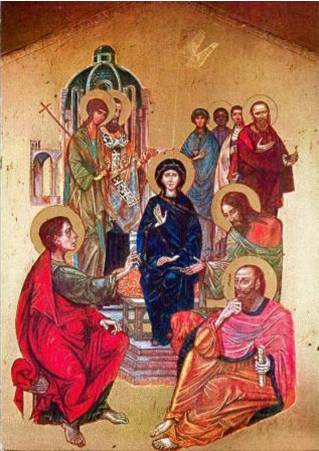
La maison de Marie (c'est-à-dire) l'Église du Christ
|
|
|
Saint Chromace d'Aquilée, évêque d’Italie († vers 407) a laissé aux Églises de tous les temps un message particulièrement fort :
« L'Église se réunit dans la chambre haute avec Marie, qui fut la Mère de Jésus, et ses frères. Donc, on ne peut parler d'Église si Marie, la Mère du Seigneur, n'y est avec ses frères : car l'Église du Christ est là où l'on prêche que le Christ s'est incarné de la Vierge ; et l'on n'entend l'évangile que là où prêchent les Apôtres, frères du Seigneur. »(1).
Dans un autre sermon, tandis que saint Chromace commente la délivrance de saint Pierre hors de sa prison, il dit ceci :
« Mais nous ne pourrons sortir de la prison, c'est-à-dire de l'erreur de ce monde, que si le Seigneur nous visite par son ange. La porte de fer, c'est-à-dire la porte de la mort et du châtiment, que le Fils de Dieu a mise en pièces par la vertu de sa Passion, s'ouvrira devant nous ; et alors nous venons à la maison de Marie (c'est-à-dire) à l'Église du Christ, où habite Marie, la Mère du Seigneur » (2).
|
|
|
(1) Saint CHROMACE d'Aquilée, sermon 30, 1, Sources Chrétiennes 164, par H.TARDIF, Cerf, Paris, 1971, p.134.
(2) Saint CHROMACE d'Aquilée, sermon 29,4, Sources Chrétiennes 164, par H.TARDIF, Cerf, Paris, 1971, p.131.
Synthèse F. Breynaert
|
|
Shlom lekh bthoolto Mariam/ Hail, O Virgin Mary/
maliath taibootho/ full of grace/
moran a'amekh - the Lord is with thee/
mbarakhto at bneshey/ blessed art thou among women/
wambarakhoo feero dabkharsekh Yeshue/ and blessed is the fruit of thy womb, Jesus/
O qadeeshto Mariam/ Holy Mary/
yoldath aloho/ Mother of God/
saloy hlofain hatoyeh/ pray for us sinners/
nosho wabsho'ath mawtan./ now and at the hour of our death./
Amîn
Je vous salue, Marie pleine de grâces ; le Seigneur est avec vous. Vous êtes bénie entre toutes les femmes et Jésus, le fruit de vos entrailles, est béni. Sainte Marie, Mère de Dieu, priez pour nous pauvres pécheurs, maintenant et à l'heure de notre mort. Amîn.


/fdata%2F3402445%2Favatar-blog-1127529851-tmpphpOIoeuT.jpg)




/http%3A%2F%2Fwww.orthodoxchristianity.net%2Fforum%2Findex.php%3Faction%3Ddlattach%3Battach%3D6480%3Btype%3Davatar)


/http%3A%2F%2Fmosc.in%2Fwp-content%2Fthemes%2Fipsr%2Fimages%2Flogocalendar.jpg)


/http%3A%2F%2Fecolepourlesgaulois.fr%2F293-home_default%2Fic%C3%B4ne-carte-postale-saint-michel-archange.jpg)

/http%3A%2F%2Fwww.librairie-emmanuel.fr%2FI-Grande-137768-icone-qualite-or-9x19-archange-st-michel.net.jpg)
/http%3A%2F%2Fwww.boutiques-theophile.com%2Fupload%2Farticles%2Fimages%2Fz2147.jpg)

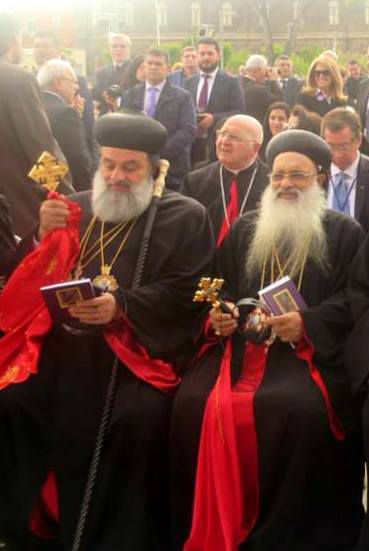
 Gros plan sur les deux responsables de l'Aumônerie Syro-Orthodoxe des Africains (Particulièrement des Camerounais)


/http%3A%2F%2Fmosc.in%2Fwp-content%2Fuploads%2F2015%2F11%2Fst.mary_1-150x150.jpg)
/http%3A%2F%2Fwww.boutiques-theophile.com%2Fupload%2Farticles%2Fimages%2Fz308.jpg)




/image%2F1498980%2F20260221%2Fob_0991ea_guerison-d-un-lepreux.jpg)
/image%2F1498980%2F20180221%2Fob_f3b37c_151210-icone-1.jpg)
/image%2F1498980%2F20180106%2Fob_959557_26166596-2000281610221488-330526446776.jpg)
/image%2F1498980%2F20241203%2Fob_bf41d0_417148169-10231157651227530-6485753101.jpg)
