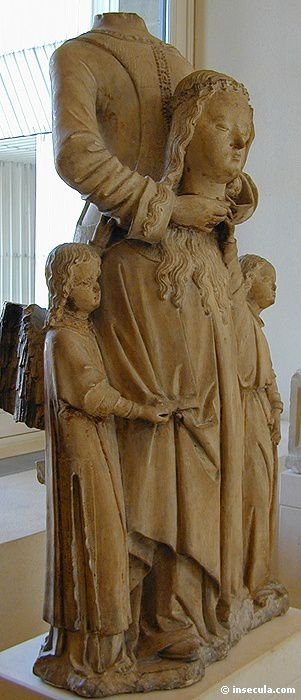
Solange naquit aux environs de Bourges, au lieu-dit Villemont, à deux kilomètres du bourg de Saint-Martin-du-Crot. Instruite par ses parents dans la loi du Seigneur, elle donna dès les premières années de son existence les marques d'une rare piété et, à l'âge de sept ans, consacra sa virginité au Seigneur, l'époux des vierges. Dieu la combla de telles faveurs que, selon une antique et vénérable tradition, elle guérissait les malades et chassait les démons par sa seule présence. Occupée à garder les moutons de son père dans un pré du voisinage, elle occupait son temps à prier son divin maître et à s'entretenir familièrement avec lui.
Un jour, l'un des fils du comte de Bourges, peut-être Bernard, comte de Bourges et d'Auvergne, rencontra la jeune bergère Solange et fut séduit par sa grande beauté. Par des avances et des promesses d'abord, par des menaces ensuite, il s'efforça d'obtenir qu'elle consente à devenir son épouse. Mais, fidèle à son vœu, elle repoussa ce projet. N'avait-elle pas décidé de n'aimer que le Christ ? Alors le jeune homme, dans un élan de furie, l'enleva de force, la mit sur sa monture et l'entraîna avec lui dans une course folle. Mais la jeune fille, qui avait moins peur de mourir que d'être infidèle à son Seigneur, se déroba à son ravisseur et se laissa tomber à terre, au bord d'un ruisseau. C'est alors que, dans sa rage, le séducteur tira son épée de son fourreau et trancha la tête de la jeune bergère. Elle subit ce martyre à la fin du IXe siècle, un 10 mai (peut-être le 10 mai 878...).
La légende rapporte que la tête de Solange, bien que séparée du reste du corps, invoqua encore trois fois le saint Nom de Jésus. Toujours selon la légende, Solange, décapitée, prit sa tête dans ses mains et la porta jusqu'à l'église Saint-Martin. Elle fut donc ensevelie en l'église Saint-Martin du village de Saint-Martin-du-Crot. Mais par la suite, une nouvelle église fut édifiée à la place de l'ancienne, placée sous le vocable de Solange, et le bourg lui-même prit le nom de la sainte martyre : Sainte-Solange (c'est la seule commune de France à porter ce nom). Le Seigneur confirma par de nombreux miracles l'héroïcité des vertus de sa servante et son tombeau n'a jamais cessé d'être honoré par les fidèles du Berry qui vénèrent sainte Solange comme leur patronne spéciale.
Saint Gordien
Martyr à Rome (✝ 362)
ou Gordan et saint Epimaque (250)
Tous deux martyrs à Rome à des dates différentes, mais célébrés ensemble parce qu'ils furent ensevelis au même endroit.
À Rome, sur la voie Latine, vers 303, saint Gordan, martyr, qui fut enterré dans la crypte où les reliques de saint Épimaque avaient été transportées peu auparavant.
Martyrologe romain
Saints Epimaque et Alexandre
martyrs d’Alexandrie (✝ 250)
Durant la persécution de l'empereur Dèce, ils furent éprouvés dans leur fermeté et leur constance dans la foi. Martyrisés, couverts de chaux vive, ils donnèrent ainsi le témoignage suprême de leur amour pour le Christ.
Fêté aussi le 31 octobre, Saint Épimaque de Péluse (Basse-Egypte) est un des 'Pères du désert' qui voulut imiter le Prophète Elie et Jean le Précurseur. Durant la grande persécution, alors que beaucoup de chrétiens se réfugiaient au désert, il s'en vint à Alexandrie pour confesser sa foi en Jésus-Christ.
Commémoraison des saints martyrs d’Alexandrie, Épimaque et Alexandre. En 250, sous l’empereur Dèce, après un long temps passé dans les chaînes et divers sortes de supplices, ils furent enfin livrés aux flammes pour la foi du Christ. Avec eux subirent le martyre les saintes Ammonarion, vierge, Mercurie, une vieille femme, Denyse, mère de famille, et une autre femme: après les tortures infligées à Ammonarion, le juge, honteux de se voir vaincu par des femmes et craignant que, s’il exerçait sur les autres des cruautés inouïes, il ne fût contraint de céder à leur inébranlable fermeté, les fit aussitôt décapiter.
Martyrologe romain
BONNE FETE AUX SOLANGE, AVEC UNE PENSEE PARTICULIERE POUR SOLANGE R notre paroissienne de Jauldes, malade.Merci à tous ses frères de la paroisse de Charente d'avoir une pensée pour elle désormais dans l'impossibilité de se déplacer pour les Liturgies.Si vous ne l'avez pas, demandez moi son N) de Tel. Un coup de fil fait toujours plaisir, surtout quand on est isolé.Que ceux qui le peuvent la visitent. Merci.
|
Dans les moments importants de votre vie, venez ici, au moins avec le cœur…
/http%3A%2F%2Fwww.catolicosalerta.com.ar%2Fsantoral%2Fimagenes%2F12-10casa_loreto-altar.jpg)
/http%3A%2F%2Fstpaulbrisbane.org%2Fkandila.gif)
|
|
|
Les responsables orthodoxes des Églises d’Albanie, de Géorgie, de Roumanie, de Russie, de Serbie, d’Italie et de Malte sont venues prier avec la délégation pontificale dans la Sainte Maison de Lorette, en Italie. L’événement a eu lieu le 5 mars 2016 ; il marque la reconnaissance officielle de la plus ancienne relique mariale – la maison de Marie à Nazareth emportées par les croisés au XIIIe s. – de la part du monde orthodoxe.
Il est en effet définitivement assuré que la Maison de la Vierge Marie à Nazareth, où a été annoncée la naissance du Christ, a été transférée en 1294 à Lorette.
Le 2 septembre 2007, le pape Benoît XVI invitait notamment à l’angélus, sur l’esplanade de Montorso, à Lorette, en présence de quelque 500.000 jeunes, à entrer dans l’esprit de cette Maison: « (…) Dans les moments les plus importants de votre vie, venez ici, au moins avec le cœur, pour vous recueillir spirituellement entre les murs de la Sainte Maison. Priez la Vierge Marie, afin qu’elle vous obtienne la lumière et la force de l’Esprit Saint, pour répondre pleinement et généreusement à la voix de Dieu. Vous deviendrez alors ses témoins authentiques, porteurs non pas d’un Evangile abstrait mais incarné dans votre vie. »
|
|
Orthodoxes et catholiques dans la maison de Marie, à Lorette
Zenit.org 9/3/16 |
|
|
Shlom lekh bthoolto Mariam/ Hail, O Virgin Mary/
maliath taibootho/ full of grace/
moran a'amekh - the Lord is with thee/
mbarakhto at bneshey/ blessed art thou among women/
wambarakhoo feero dabkharsekh Yeshue/ and blessed is the fruit of thy womb, Jesus/
O qadeeshto Mariam/ Holy Mary/
yoldath aloho/ Mother of God/
saloy hlofain hatoyeh/ pray for us sinners/
nosho wabsho'ath mawtan./ now and at the hour of our death./
Amîn
Je vous salue, Marie pleine de grâces ; le Seigneur est avec vous. Vous êtes bénie entre toutes les femmes et Jésus, le fruit de vos entrailles, est béni. Sainte Marie, Mère de Dieu, priez pour nous pauvres pécheurs, maintenant et à l'heure de notre mort. Amîn.
|
|
En mai soyez Missionnaire de Marie, Mère de Miséricorde, abonnez vos amis à la "Newsletter", aidez le Monastère Syriaque et ses missions, venez en Pèlerinage !...
|
|
St. Aho the ascetic (+524)

St. Aho was born around 419 A.D. in the city of Rish'aino (Ras ul-'ayn now), which is to the south and east of Nisibis in present day Syria near Hassekeh, his father's name was 'Ubadyo, Aho was one of his three children. At the age of twelve became the disciple of a local monk, and the Lord bestowed wisdom on the child and he was enlightened and became wiser than all the other children in the instruction.
Around 439, Rish-'aino comes under Persian siege. The great army went up and they came to Nusaybin and the Romans retreated before them. They chased after them unto Harran. When the Persians returned, he commanded Nabon the Commander, that they should go out and capture and bind all of them. They began to flee across the Euphrates river. All the residents migrated to the West. The remainder were captured by the Persians. They pillaged and burned all their villages.
During this time. 'Ubadyo father of Aho came to him and said “My son, behold, our residents wait outside the gate of the city. Behold, your mother, and your brothers are with them. Rise, we shall go to them. “He agreed and went with him. When they came to the camp they sat until many people gathered, without number. They came to the bridge to the west of the city. When they crossed over the bridge of Euphrates they trampled each other much. About 200 people died, men, women, and children. When the Blessed Aho saw this, he returned to the city. His father, mother, and brothers went on their way. When they came to an inn of that day they sought and did not find him. They thought an accident happened to him. They mourned and wept. They gave up looking for him and went on their way.
They arrived at the city of 'Akka ('Aku) on the Mediterranean Coast.. His father died on the way but his brothers, because they knew how to fish, were fishing there, because the city was built by the sea. When they learned the city and the region, they took for themselves wives from there. They bought for them a boat for cargo. They were sailing to every place that they desired on the sea. Their mother sat with them in mourning because of the Blessed One.
Mor Aho is captured
Mor Aho returned to Rish'aino, he thought to himself that he might follow the life of an Anchorite, when he was thinking on this, met another young man about his age and he told him about his desire. They both decided to become Anchorite monks, and both decided to go to Nusaybin (Nisibis). When they were traveling on the road, behold there was a unit of a troop of Persians leading many captives. They caught the youths and bound them. They arrived at Nusaybin where they gathered all the captive. They were in number about 7000 souls. They were taken to the east of the city. Nabon the commander went with them and all the troop with him. The captives passed in front of them. Although Nabon was a pagan he was a compassionate man. He ordered the youth, the males and females, little boys and girls only, to be taken and released to their land. When they reviewed, they chose about 3000 souls and they released the remainder and returned them. They were led down to Persia and showed to the King. The King commanded that they should take one third of them for him and two thirds for the commander and the soldiers with him. They cast lots in accordance with the grace of the Messiah, who in every time helps those who do his will.
Mor Aho was given to a Christian soldier Michael to serve as a slave or indentured servant. Michael discovers that Aho is a Christian and they make a pact to serve together in the military, so Michael takes Aho to the King, (who most likely was Yazdagrid II). Michael tells the King that Aho is his nephew on his mother’s side, and he convinced the King to make Aho a soldier that he may become one like him and given him a salary. The King saw in the Blessed One a countenance like the countenance of an angel. He favored him and ordered his master-chief. He gave him a horse and a mule and weapons that soldiers use and gave to him much silver. He registered him like one of the soldiers.
Aho and Michael leave the military
Mor Michael and Mor Aho served in the Persian army for 18 years. In around 458 A.D. They decided to follow Lord's steps when one day they stood in prayer until midnight according to their custom. While sackcloth and ashes was underneath them they were singing and saying, “O Lord show us the way to go towards you. O Lord we lift up ourselves.” (Ps.1:1) When they said this they fell into a deep sleep. The two Blessed Ones dreamed one dream. They saw a man of a beautiful appearance standing over them. His countenance was illuminated like the sun. He was wearing glorious clothing and standing over them. He said to them, “My brothers, rise, ascend at once together to the region to the west, for there the Lord prepares for us a place that we might dwell in it.” When they awoke from their sleep, those Blessed Ones related one to another what they saw. They rejoiced greatly for they realized that the Lord prepared before them his way. Very early in the morning they put their things on their mounts, everything they owned.
Miracles and Monks
They traveled to Nisibis, the place of Mor Aho’s capture. They entered the village of Teldoros [Tel-Darius (Dara)]. When they arrived at an inn on the way, they saw a certain village that was called Teldoros. They turned to the house in it. Now there was a master of the village, a certain man, a believer called Theodoros. When he saw them from afar he said to his master chief, “Behold, I see upon the road two solders. Take them to our dwelling.” When the master chief went out to their way he took them in and welcomed them and gave them water and washed their feet. He gave them bread and straw and fodder for their mounts. He was thus accustomed to do this for all travelers of the road.
Now Theodoros had a son, a deaf mute from his mother’s womb who was called Heworo. When the boy saw the master chief carrying implements and useful things for the two, he signed to his father in three fingers. He indicated to him there were three. Because the child saw three, the father was astonished at him and did not know what he was saying to him. When it was evening he made for them a dinner and he served and sat as they were eating. He gave drink to only those two. The boy signed to give to the other one. But his father thought he was mocking. His father became angry and said to the servant to take him out. But these Blessed Ones let him stay. He was silent and did not sign again.
After the dinner a little while Theodoros left the Blessed Ones and went to his bed. But the child, Hewaro remained with them while he slept. When they rose in prayer they said to each other this is the time for the name of the Christ (Messiah) to be praised by us for this child. They prostrated and they prayed and their tears ran before God, before they finished their prayer the child Heworo awoke and rose from his bed and ran to the feet of the Blessed Ones and he began kissing them. When the Blessed One saw him they fended him off. But that one began speaking with them in a straight tongue. When they heard his speaking, they rejoiced greatly and they praised God and asked him when they said to him, “How did your tongue get straight?”
But that one said to them that, “There was a man with you in the evening and he took me by the hand and gave to me a cup of cold water. When I drank he said to me, “Rise, go now near these ones.” When I came near you my tongue was straightened.”
When they miracle was known, the fame of Aho and Michael spread throughout the region and Theodoros offers to build them a monastery about a mile east of Tel-Darius in the village named Kasar. In Kasar St. Aho and Michael create a monastic community. Mor Aho and Mor Michael had a dam built for fish, vineyards planted, and many kinds of trees. About 20 monks joined the two saints in the monastery. Later, Mor Aho and Mor Michael are offered a nearby vineyard in the village of Zamorto (Kfar Zamoro is the name of the ruin today). In Zamorto, St. Aho casts a demon out of a man called Hobel.
Discovery of his long-lost family
The Blessed One, Mor Michael, after he remained with community five years, he returned to the region of Nineveh and built for him there a monastery. He built a pillar in it and sat upon it until his departure around 463 A.D. It is also about the same time that Aho takes a trip to Jerusalem for a year and a half. On his return he decides to follow the Mediterranean coast. At 'Akka he boards a ship which turns out to be owned by his brothers. After they question each other about their family history, final proof is given to the brothers. It is a birthmark or a mark from an injury on his shoulder.
He departs from the vessel in Antioch. His brothers cannot persuade him to return to 'Akka with them and meet his mother. He quotes scripture to them from Matthew 17:20, “Unless a man forsakes his father, mother and brothers he cannot be a disciple.”
When Mor Aho’s mother learns of this event after the brothers return she travels to Antioch, catches a caravan to Nisibis. The determined mother finds Mor Aho near his monastery. She suffers from heat exhaustion and her son gives her a drink of water. He takes her to the monastery knowing it is his mother but not revealing himself to her. When he finally reveals himself to his mother, she is speechless for an hour, weeping and crying for joy. Then she scolds him for causing her so much grief. Mor Aho out of guilt and devotion stays by her side for nine years until her death (474 A.D).
More Monasteries and Conversions
About this time Theodoros dies also, but not until after he builds another monastery for Mor Aho in Tur'abdin. He names the monastery the White Monastery after Hewaro the son of Theodoros. An additional donor to the monastery is Demetrius, who owned the fortress of Tur'abdin. He had a mausoleum built for himself but with enough room so that when Theodoros died, he was buried in it also.
After the death of his mother and Theodoros, Mor Aho leaves his community again and travels to a village called Hadas. Here he is invited by a childless woman, Dorsela, to be her guest. The servant girl of the woman tells the husband upon his return and makes it sound as if Mor Aho is up to no good. He has Mor Aho thrown in prison. Only after the girl confesses due to a dream, does the husband, named Maximus, rush to the prison and release Mor Aho begging him his forgiveness. Mor Aho confronts the girl and casts a demon out of her called Legion. The demon curses Mor Aho upon his leaving the girl and the region. Mor Aho blesses the girl and announces that she will have twins.
Mor Aho continues his journey and arrives in Athens where he stays for five year which must have been about the year 480 A.D. He continues his journey to Constantinople and lands a job helping the warden of the Church which contains the True Cross. After four years he convinces the warden to take a tiny silver of the True Cross and leave with him.
Mor Aho returns to Hadas apparently without the warden for he is not mentioned again in the story. Dorsela and Maximus are now the parents of seven children. They give their oldest son, Rumanos, to Mor Aho as a disciple. Mor Aho remained in the village two years.
Mor Aho then ventures into Armenia near the village of Ause where he encounters pagans who are celebrating under a giant tree. in whom they believe there is a god. Mor Aho observes the carnal activities and weeps and prays for them. He is discovered and two men bring him to the feast. Mor Aho fears for his life and prays to God. A tornado rips up the tree and casts it in the river about a mile away. The people are furious at Mor Aho for ruining their party. They want to kill him because he tells them that the God of Jesus Christ is his god. Others Christian missionaries had tried to convert them before he is told. They demand that the tree be brought back and their gods with it. Another storm comes and blows all the animals in the river. Two hours of darkness inhabits the land. The pagans relent and are converted to the faith of Mor Aho.
Mor Aho has a church built and sends for the Bishop of Miletene. Bishop Koriokos of Miletene comes and they baptize many people and ordain many priests and deacons. A monastery is built Mor Aho resides there for 22 years. According to the periods of time identified in the story, this takes place about the year 508 A.D.
The Death of Aho
The blessed St. Aho put on years and it seemed to him that he was sick unto death. When the villagers heard, they all gathered around him weeping much. When the Blessed One saw them he quieted them and comforted their heart and said to them, “My brothers this is the end of every man.” But those ones were very sad about his departure. They wept and they said, “O Father of Peace and Mercies, where shall we go to find you and who shall be a leader for us like you? Stretch to your right hand and confirm your sons and daughters while we are standing. Give to us peace and go in peace, merciful peace. Then go to the region of pleasures. We remain here tormenting ourselves. O Good Shepherd where will you go. Your flock is left without a shepherd. You saved us from the mad wolves that would have torn us apart.”
When the Blessed One heard all this suffering he rose and sat on his bed and opened his mouth and spoke with them and said unto them, “Since you offended me in the time of my death I know that the Messiah has called me to not leave you. He stretched out his hand and signed them with the Cross. He committed them to the Messiah and said to them, “O Messiah you labored from my youth to my old age. He shall guide you in all purity and holiness.” He turned and kneeled in prayer and prayed thus, he said,
“O Lord God, mighty and holy, give to your servant in this hour the petition that I ask from you.
May every region or house or village be reminded of your name and the name of your servant.
May there not be a single house from among them with sickness, nor paralysis, nor weariness from evil, nor difficult diseases.
Also do not make barren its houses. Give them times of peace and seasons of blessings. Make them fervent in abundant exaltations and continual bounty.
Make them fervent in all goodness and in every place where they perform vigil or intercession.
In your name and in the name of your servant may there not be hail, nor blight, nor locust, nor plague.”
He turned to them and said, “My moment arrives.”
When he said these things they thought to themselves that it was not the end. But he gave his soul to the Creator for eternal sleep. His face was illuminated like the sun. But those ones when they saw that he died they were weeping violently and they made a great lamentation without end. The women were mourning for him like the Hebrews mourned for Aaron. All the region gathered and they made a great procession and service for three days. They embalmed him in Maroon. They wrapped him in pure silk and expensive incense. They buried him in a grave of the monastery. Every man began to lament for him. Two disciples remained and they wept much. All the people gathered and they lamented about the death of the Blessed One.The days of the life of the Blessed One were 105 and his departure from this world was in the month of January 25th. 524 A.D. May the Lord enlarge his remembrance!. Amen..
Today in the Bysantine Tradition:
Tropaire, t. 3
Saint apôtre Simon, * intercède auprès du Dieu de miséricorde, * pour qu'il accorde à nos âmes le pardon de nos péchés.
Kondakion, t. 2
Tous ensemble, par des hymnes louons * comme bienheureux l'apôtre Simon, * lui qui dans l'âme des fidèles déposa * sans faille la doctrine de la sagesse; * car devant le trône de gloire à présent * il exulte avec les Anges incorporels, * sans cesse intercédant en faveur de nous tous.
Ikos
Tous ensemble, acclamons à présent * la mémoire de l'Apôtre comme jour de salut; * disons-la bienheureuse, en notre foi, * car elle fait briller sur l'univers * la lumière d'un soleil dissipant * toute brume sous l'éclat de ses rayons * pour éclairer les fidèles célébrant * et glorifiant sa mémoire avec amour. * Nous-mêmes, accourons de tout cœur * et chantons-le, car il se tient auprès du Christ, * sans cesse intercédant en faveur de nous tous.
Exapostilaire (t. 3)
Apôtre du Christ compatissant, * toi qui as vu le Seigneur de tes yeux, * demande-lui la paix pour le monde, * la victoire pour le peuple chrétien, * pour nous-mêmes la rémission de nos péchés * et le salut pour tous ceux qui t'acclament comme son disciple, saint apôtre Simon.
http://calendrier.egliseorthodoxe.com/sts/stsmai/mai10.html
Apostle Simon Zelotes and St Isidora the Fool of Tabenna
May 10
/http%3A%2F%2Fstpaulbrisbane.org%2FSimonAndIsidora1.jpg)
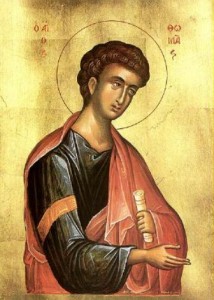
Simon was one of the Twelve. He was born in Cana of Galilee; some accounts say that he was the bridegroom at the wedding at Cana, where the Lord Jesus performed his first sign (John ch. 2). After receiving the Holy Spirit at Pentecost, he preached the Gospel in Africa; he was privileged to die by crucifixion, like his Lord.
Isidora was a nun in a monastery in Egypt, and pretended madness and mental weakness in order to hide her virtues and her ascetic life. She did the dirtiest jobs, lived on scraps from the nuns' tables, and was despised by her sisters.
An angel appeared to the ascetic Pitirim and revealed Isidora's true sanctity to him. He came to the monastery and, seeing Isidora, prostrated himself before her, at which she prostrated before him.
When the sisters told him that she was mad, he answered "It is you who are mad: she is greater before God than either you or me. I only beg God to give me also that which is destined for her at the dreadful Judgement." At this, the sisters' eyes were opened, and they began to treat Isidora with honour. But she, to avoid being honoured by anyone, fled the monastery and was not heard from again.
(Sources:Ancient Faith Radio/ http://ancientfaith.com/ )
Aujourd'hui il y a 1112 jours qu'ils ont été enlevés et nous n'avons toujours pas eu de nouvelles d'eux....Nous espérons...

N'oublions-pas de prier pour les évêques, prêtres et
fidèles chrétiens détenus par les "islamistes"
ou terroristesen tous genres !
Prions sans relâche pour que le
Seigneur les soutienne. Prions pour leur libération ...

Let us not forget the bishops, priests and faithful
Christians held by "Islamists" or terrorists of all
kinds! Pray tirelessly for the Lord to sustain them.
Pray for their release ...
Aujourd'hui il y a 1111 jours qu'ils ont été enlevés et nous n'avons toujours pas eu de nouvelles d'eux....Nous espérons...
N'oublions-pas de prier pour les évêques, prêtres et
fidèles chrétiens détenus par les "islamistes"
ou terroristesen tous genres !
Prions sans relâche pour que le
Seigneur les soutienne. Prions pour leur libération ...

Let us not forget the bishops, priests and faithful
Christians held by "Islamists" or terrorists of all
kinds! Pray tirelessly for the Lord to sustain them.
Pray for their release ...


/fdata%2F3402445%2Favatar-blog-1127529851-tmpphpOIoeuT.jpg)

/http%3A%2F%2Fwww.orthodoxchristianity.net%2Fforum%2Findex.php%3Faction%3Ddlattach%3Battach%3D6480%3Btype%3Davatar)


/http%3A%2F%2Fsged.bm-lyon.fr%2FEdip.BML%2FPubliImg%2Fimages%2FENLU%2F00%2F00%2F0F%2F1B%2FGED_00000000.JPG)












/http%3A%2F%2Flepeuple.be%2Fwp-content%2Fuploads%2FDavutoglu-net-e1458320571240-638x400.jpg)
/http%3A%2F%2Flepeuple.be%2Fwp-content%2Fuploads%2Fmigrants-Kos-afp-700x394.jpg)

/http%3A%2F%2Fwww.france-catholique.fr%2Flocal%2Fcache-vignettes%2FL200xH133%2Farton18912-694ab.jpg)
/http%3A%2F%2Fwww.france-catholique.fr%2Flocal%2Fcache-vignettes%2FL200xH150%2Farton18906-bd5e0.jpg)


/http%3A%2F%2Fimg15.hostingpics.net%2Fpics%2F157920wasmer1.png)


/http%3A%2F%2Fblog.sami-aldeeb.com%2Fimages%2F2016%2F05%2Fbookcoverimage-1.jpg)


/image%2F1498980%2F20221010%2Fob_34c6b9_41537163-10217101933923382-54803524483.jpg)
/image%2F1498980%2F20240621%2Fob_b0011b_1795567-10202721425670303-198965239-n.jpg)
/image%2F1498980%2F20150621%2Fob_833215_communion-of-the-apostlesflyer.jpg)
/image%2F1498980%2F20190302%2Fob_4fe135_53423668-10218381709316967-79131208379.jpg)
